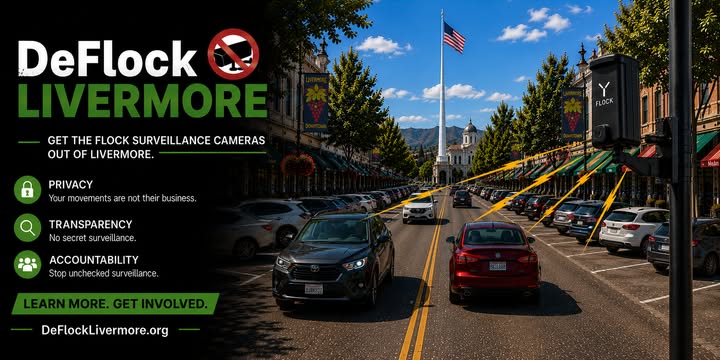
Our streets.
Our rights.
DeFlock Livermore.
Catch the bad guys. Don't track anybody else.
DeFlock Livermore opposes indiscriminate automated tracking of people who are not suspected of a crime. Police should have effective tools to investigate actual suspects without building a searchable history of everybody else's movements.
This is an advocacy site with a point of view. Its factual claims should still be checkable, so we link the source beside each one.
What are Flock cameras and ALPRs?
ALPR stands for Automated License Plate Reader: a camera system that captures license plates and vehicle information and turns those observations into searchable data. Flock Safety is the vendor Livermore Police identifies for its ALPR system. Livermore Police says its Flock system supports retroactive searches and real-time hot-list alerts.
Livermore owns and maintains approximately 310 centerline miles of paved streets. At the 78-camera count in Livermore Police's 2025 ALPR Annual Report, that's roughly one ALPR for every 4.0 miles (6,995 yards) of Livermore streets.
Do we really want Livermore to become China 2.0?
Livermore at a Glance
Each figure is tied to the dated record linked in its row. Where a record does not state a number, we say so rather than guess. Last checked against those records on 17 October 2026.
Documented stated in the record (click to open it) · Calculated our arithmetic from documented figures (hover or tap to see it) · Unknown not established by any record we have. Found an error or a better primary source? Tell us.
| Measure | Current / latest verified record | Future projection in the record |
|---|---|---|
| Flock / ALPR cameras | Documented · 2025 report ↗ 78 ALPR cameras in Livermore Police's 2025 ALPR Annual Report. Documented · Flock portal ↗ Livermore PD's Flock transparency portal (updated 17 Oct 2026) lists 148 total active cameras, described as 75 Flock ALPR cameras and 73 non-Flock "ALPR capable" traffic cameras. Unknown how many of those traffic cameras actually read plates. Calculated Put another way: Livermore owns and maintains approximately 310 centerline miles of paved streets. At the 78-camera count in the 2025 report, that's roughly one ALPR for every 4.0 miles (6,995 yards) of Livermore streets. City street-mileage source → | The City's capital plan says project PS201722 will increase the number of ALPR systems and identifies remaining downtown-core installations after the L Street Garage is completed. It does not state a final future camera count. |
| Vehicles recorded | Documented · Flock portal ↗ 1,201,553 unique vehicles detected in the 30 days before 17 Oct 2026, while Livermore PD ran 238 search sessions in the same 30 days. Calculated About 5,000 unique vehicles recorded for every LPD search session. | Not published as an annual figure. The 2025 ALPR Annual Report does not state total detections. More on the denominator ↓ |
| Flock contract | Documented ceiling · Council minutes ↗ The second amendment to the City's Flock agreement raised it to a not-to-exceed amount of $815,000 (Resolution 2025-088, approved 5–0 on the 9 June 2025 Consent Calendar). That is a maximum, not money spent. Unknown Actual payments to Flock to date. | The record sets a ceiling. It does not project spending by year. |
| Budget / project funding | Documented · City CIP ↗ $55,000 in FY 2025–26 for ALPR project PS201722, funded from Asset Seizure – County, not the general fund. | The same project table shows $0 in each listed period after FY 2025–26 through FY 2030–45. That is the City's published project projection, not a claim that no future ALPR spending can ever be approved. |
| Retention / searchable travel history | Documented · Policy 460 ↗ Documented · 2025 report ↗ Documented · Flock portal ↗ At least one year. Policy 460.6 (Lexipol revision dated 9 Sept 2026) says ALPR data downloaded to the server should be stored for a minimum of one year, then purged unless it is, or may become, evidence. The 2025 Annual Report says data is deleted within one year unless it becomes evidence. The Flock portal lists 365 days. | Flock announced a seven-day recommended default in August 2026. As of 17 Oct 2026, Livermore's portal still lists 365 days. |
| Who can access the data | Documented · Flock portal ↗ The Flock portal lists the organizations granted access to Livermore's data. Calculated 340 organizations on 17 Oct 2026, by our count of that list. | Policy 460.8 bars sharing with federal, out-of-state and private entities, with narrow exceptions. The policy itself states no future list. |
The contract price is not the Total Cost of Ownership.
The published Flock contract or project expenditure represents only the costs identified in those records. It should not be interpreted as the complete cost to Livermore taxpayers of operating an ALPR surveillance program.
Operating the program also consumes resources such as personnel time for administration, monitoring, investigations and dispatch; police and IT management; networking and communications; servers, storage and other IT infrastructure; cybersecurity; facilities and real estate; electricity and cooling; maintenance; training; records management; legal and compliance work; and other support.
Many of those resources may already exist and would continue to exist without Flock. Existing does not mean free. The ALPR program consumes a portion of shared personnel, infrastructure, facilities and operating resources, and the appropriate portion of those expenses contributes to the program's Total Cost of Ownership.
DeFlock distinguishes between incremental costs created specifically by the ALPR program and allocated costs representing the program's appropriate share of existing resources. Both matter when determining what the program actually costs taxpayers.
The City's capital plan says the ALPR expansion project will have "no additional O&M costs." That is a statement about one project budget. It is not an accounting of the staff time Policy 460 itself requires: annual training for every authorized user, quarterly audits, dispatch confirmation of alerts, and an annual report. Unknown what those cost.
DeFlock Livermore is working to identify those additional costs so the public can see something closer to the true Total Cost of Ownership—not merely the price appearing on the vendor contract or project budget.
The surveillance denominator
Success stories report what the system found. The denominator shows how much routine travel was recorded to find it.
unique vehicles detected in Livermore in 30 days
Livermore PD search sessions in the same 30 days
unique vehicles recorded for every LPD search session (1,201,553 ÷ 238)
hotlist hits in the same 30 days
All four figures come from Livermore PD's Flock transparency portal as updated 17 October 2026. They are a rolling 30-day snapshot, not annual totals.
LPD's 2025 ALPR Annual Report lists 225 stolen-vehicle hits, 23 felony-vehicle hits and 84 calls for service generated from ALPR information. Unknown The report does not give 2025 totals for detections, unique plates, searches, arrests, recoveries or false alerts. Without them, the year's outcomes can't be set against the scale of collection over the same period. What records would complete the picture →
The photograph isn't the issue. The searchable history is.
Where are Flock cameras in and around Livermore?
This community-maintained DeFlock map shows reported automated license-plate-reader locations around Livermore. Camera locations can change. The map shows what volunteers have documented, not every camera in Livermore. Livermore PD's own portal lists 148 cameras.
They are keeping ALPR images and data about all of our whereabouts online, searchable, and hack-able, for one full year. That's a long time for our personal travels to be kept on-file by the government that we fund.
Livermore's current written policy keeps ALPR data for a minimum of one year. Policy 460.6 says data downloaded to the server should be stored for at least a year, then purged unless it is, or may become, evidence. The Flock portal lists 365 days. In August 2026 Flock announced it would lower its recommended default to seven days. Existing customers keep the periods their jurisdictions approved, and as of 17 October 2026 Livermore's portal still listed 365 days.
Recording doesn't wait for suspicion. Policy 460 defines a detection as the system reading any plate in public view, and LPD's annual report says the technology operates continuously. The policy's safeguards, such as a case or CAD number and a stated reason, apply when someone searches the data, not when your car is recorded.
Watch & support @LoyalMoses
@LoyalMoses is fighting the good fight well beyond DeFlock. His own description of his work is that he explores the intersection of technology and independence through cinematic storytelling. His recent work has repeatedly focused on Flock, mass surveillance, public access to camera data, and other technology-policy issues that affect privacy, civil liberties and individual independence.
DeFlock Livermore appreciates the time, research and energy he puts into helping people understand these issues. If you care about civil liberties—not just ALPR cameras—his work is worth following.

Watch the featured video on YouTube →
Join DeFlock Livermore on Facebook
Connect with local residents, share information, organize and stay informed.
One ALPR camera is one ALPR camera too many.
That is our campaign position. We oppose routine, suspicionless collection of vehicle-location data and want Livermore to end its Flock program.
READY TO TAKE ACTION? →